

After six months of curated news on AI and Education, there are themes emerging in how we have and how we are starting to talk about and focus on the use of AI in education.
Since June there have been weekly summaries published in our AI and Education Studio publication. These summaries are curated following a scripted process and utilize pre-selected sources including vetted news sources, professional publications, vetted social media accounts, research publications, think tanks, nonprofit organizations, and our weekly engagements with groups and organizations.
The goal has been to curate a high quality weekly list of happenings focused on artificial intelligence (AI) in education.
The process that we have used to curate these news briefings has been somewhat invisible to our readers. However, we have tracked the interactions, sources, findings, etc. over time. The point of these briefings is not just to share what we are reading, it is also to monitor trends over time.
This report synthesizes the content of the articles published between June and October 2025 in The AI and Education Studio. The analysis focused on identifying recurring themes, emerging patterns, and shifts in emphasis within discussions about AI in education.
The findings from this (our first mid-term report) indicate that AI literacy, governance and privacy, educator professional development, and policy frameworks are the most consistent themes highlighted in the news and weekly updates as they related to AI and Education.
The overarching message is clear: the field is shifting from “talking about AI” to “designing systems that use AI responsibly.”
Scope and Methodology
The analysis focused on articles published in The AI and Education Studio weekly between June and November 2025.
For each article, key metadata were captured, including the title, author, publication date, first and second level headings, and the complete body text.
Once the articles were collected, the data underwent a structured cleaning and preparation process. Non-content elements such as navigation menus, comments, and metadata artifacts were removed to ensure that the analysis reflected only the substantive text of each article.
The cleaned text was then segmented according to second-level headings or natural paragraph divisions, creating coherent sections for analysis. Each article was subsequently tokenized, divided into meaningful textual units to enable systematic identification of themes and recurring ideas.
The thematic coding followed an inductive approach, allowing major themes to emerge from the content while remaining grounded in consistent conceptual categories.
Twelve thematic areas were used as a framework for classification.
- AI literacy
- Assessment redesign
- Teacher professional development and agency
- Data governance and privacy
- Implementation in low-resource settings
- Cybersecurity and safety
- Higher education readiness
- Policy and frameworks
- Infrastructure and compute
- Hype versus practical adoption
- Student engagement and learning science, and
- Ethics and dignity.
Our methodology allowed for both qualitative interpretation and quantitative tracking of how often each theme appeared, setting the foundation for the subsequent analysis of trends and shifts in focus across the publication period.
Overview of Major Themes
Across the articles analyzed, the curated news demonstrated both a coherent and evolving narrative about the maturation of artificial intelligence in education.
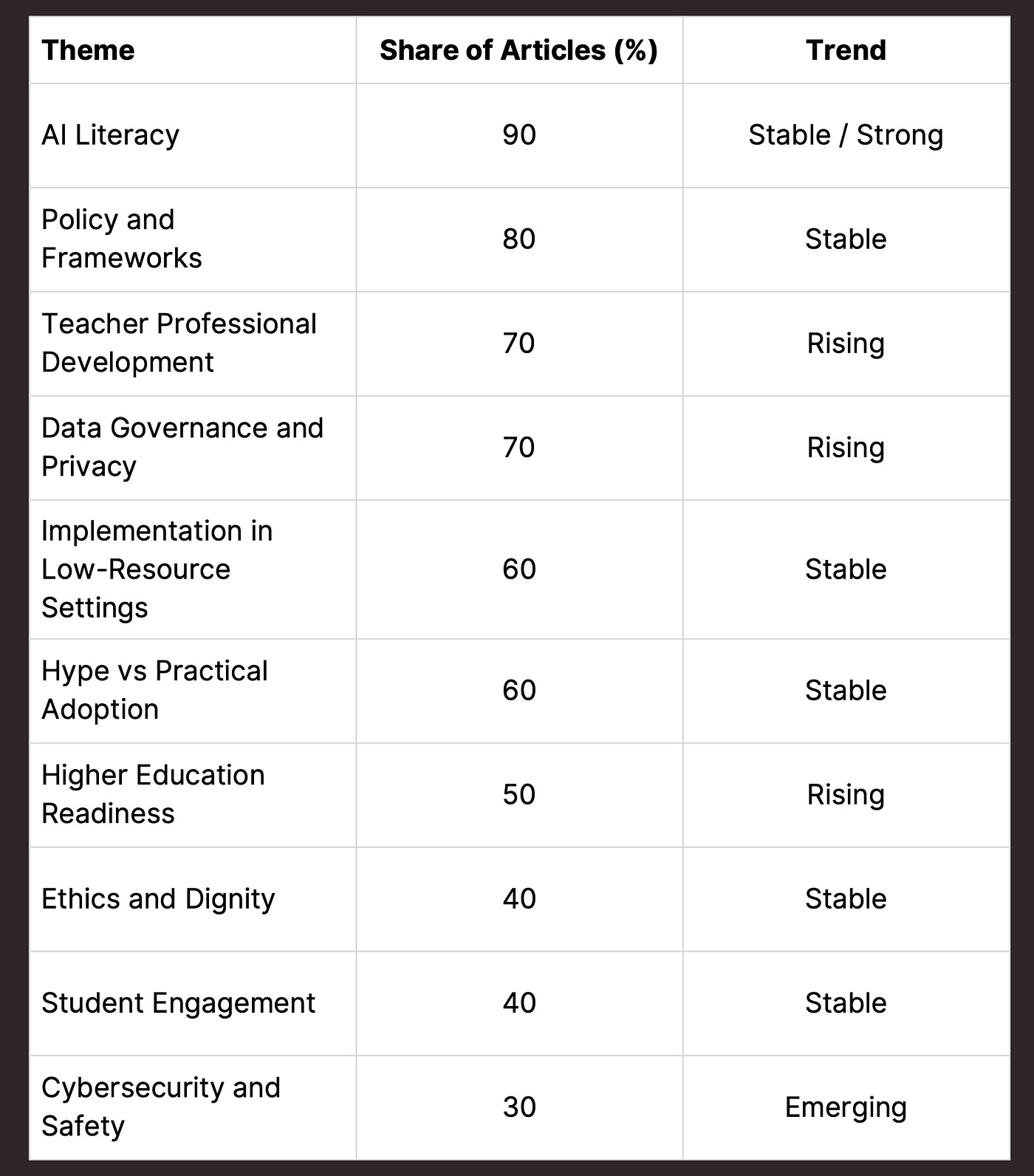
Our analysis demonstrated that the global discussion on AI and education has clearly moved from speculative enthusiasm toward structural readiness. Rather than celebrating tools, the curated articles demonstrate a focus on systems that prioritize human judgment, ethical alignment, and educator capacity.
The most dominant thread is AI literacy, consistently framed not as a set of technical competencies but as a unique discipline. Articles challenge the notion that exposure to AI equals understanding, warning that schools risk mistaking digital polish for genuine learning. The emphasis is on metacognition, helping learners think critically about AI outputs, question their validity, and use these technologies to deepen rather than replace human thinking.
This repositioning signals a shift from early adoption to reflective integration, where agency (not task completion) becomes the true measure of readiness.
Closely intertwined is an apparent call for governance, privacy, and ethical infrastructure. Repeated references emerged in our analyses that focused on data transparency, algorithmic fairness, and modernized privacy laws. Our analysis demonstrated an initial footprint that education as a sector is waking up to its accountability obligations.
An underlying theme throughout the weekly briefings was that progress depends not on experimentation but on the establishment of governance mechanisms that can scale responsibly.
Thematic Synthesis
The human dimension remains central through the focus on educator professional development and agency. Teachers are positioned as both the opportunity and the constraint in AI adoption.
Our analysis repeatedly underscores that meaningful integration will only occur when educators possess the confidence and critical understanding to guide students’ ethical and effective use of AI.
At the policy level, the curated articles highlighted how national coordination and frameworks are beginning to translate. Examples from UNESCO, Kenya, Morocco, Thailand, and Chile illustrate that explicit frameworks serve as the scaffolding for ethical innovation.
Where these structures exist, implementation appears to advance more coherently, with fewer governance gaps and clearer pathways for evaluation. Though still in their infancy, this is something to monitor over time.
Equity remains a consistent undercurrent, particularly through the lens of implementation in low-resource settings. The work in Africa and Asia is intentionally developing inclusive, multilingual, and locally adapted AI solutions.
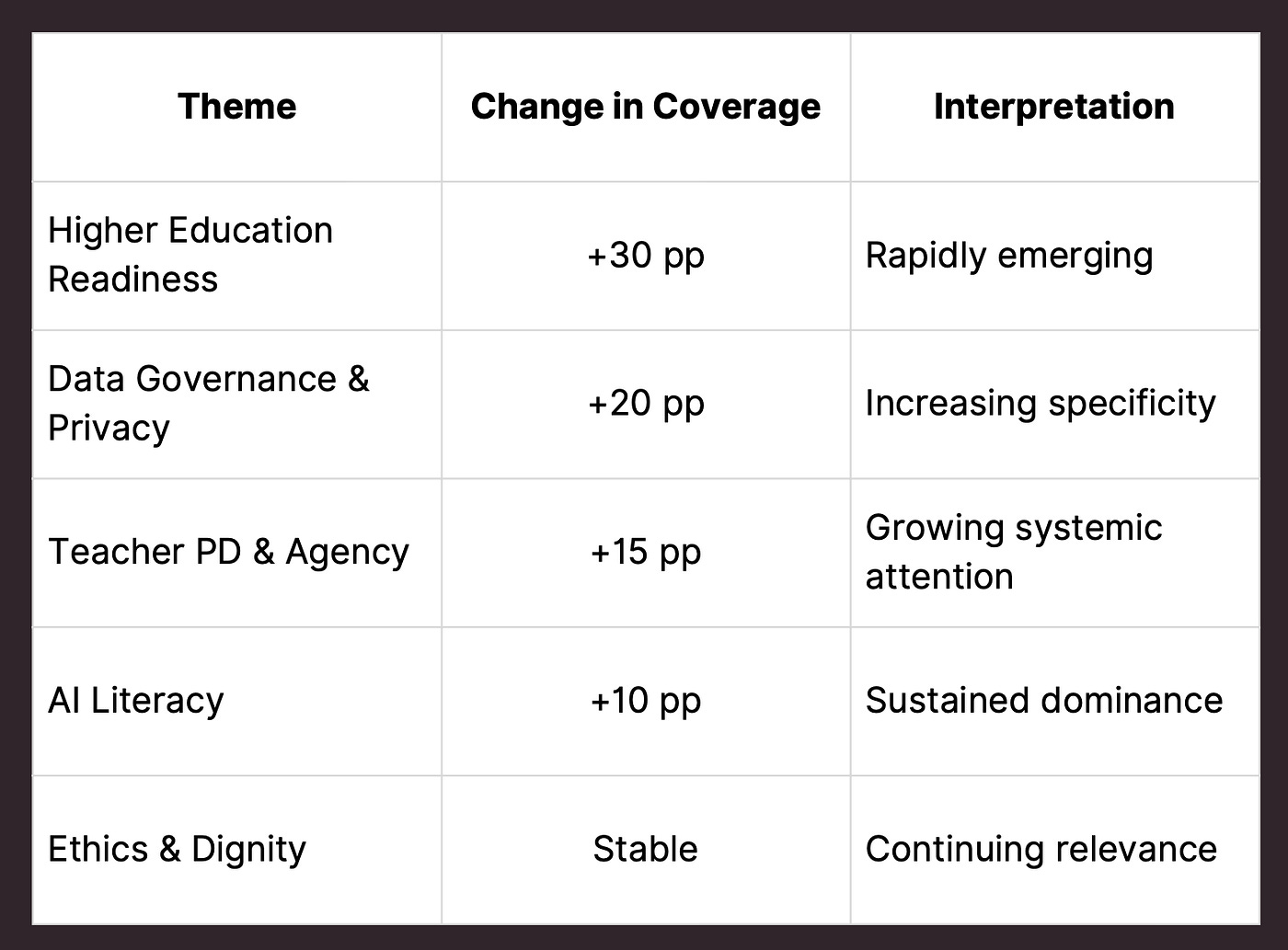
Finally, a clear emerging theme is higher education readiness. News started to emerge in September that was more finely tuned into how universities are preparing learners for an AI-driven workforce. The articles around this topic demonstrated emergent conversations around institutions moving beyond superficial engagement to embed AI ethics, data literacy, and interdisciplinary practice into curricula.
Shifts Over Time
The demand from students for relevant, career-aligned learning signals both an opportunity and a warning: higher education that fails to evolve risks deepening the readiness divide.
Taken together, these themes describe a higher education ecosystem that is shifting from conceptual exploration to operational design.
The curated news from the first six months signaled a sector beginning to reconcile aspiration with responsibility, recognizing that ethical and inclusive AI in education will not emerge by chance but through deliberate, well-governed systems that keep human understanding at the center of innovation.
Implications and Recommendations
The findings from this analysis make it clear that education systems are standing at an inflection point. AI is no longer a distant innovation to be considered; it is a unique force that demands intentional design and ethical stewardship into the education sector.
Across every theme that emerged the same challenge was present in our analysis: how to turn awareness into action that truly improves learning.
For education leaders, the path forward lies in shifting from small-scale pilots to governed programs that include clear decision rights, defined review cycles, and transparent measures of learning impact. The experimentation phase has served its purpose; the next step is disciplined implementation. Leaders must also ensure that AI literacy is not treated as a side topic, but as an integrated part of curriculum standards that nurture judgment, reasoning, and ethical reflection alongside technical skill.
Policymakers have an equally urgent role to play. As AI becomes embedded in educational operations and learning tools, traditional data privacy policies no longer suffice. Frameworks must explicitly account for AI model use, algorithmic accountability, and consent mechanisms that protect students and educators alike.
Given what we have learned about what is happening in the field during this first six months, there is some initial data to suggest that prioritizing teacher and administrator capacity-building aligned with global standards (such as the UNESCO and OECD AI competencies) may help educators interpret, apply, integrate, and evaluate AI tools responsibly.
At the classroom level, practitioners hold the key to transforming AI from a novelty into a partner in learning. Teachers can model responsible use by designing assignments that make students’ thinking visible and emphasize process over product.
The goal is not to replace creativity but to enhance it, encouraging students to question, design, and revise with AI as a tool for exploration and agency rather than automation.
Our analysis demonstrates that the curated news related to AI and education is starting to highlight that effective AI integration is less about the technology itself and more about the human systems that surround it.
Sustainable progress will depend on thoughtful governance, ongoing professional learning, and assessment practices that keep human judgment at the center.
As AI becomes part of everyday education, the question has shifted from if to how it should be used. The analysis shows that effective integration depends on governance, capacity, and ethics working together. This section offers possible points for leaders, policymakers, and practitioners to move from awareness to action, ensuring that AI strengthens learning, equity, and trust rather than simply adding new tools.
Recommendations
- Move from pilot projects to governed programs with defined roles, review cycles, and measurable learning impact.
- Embed AI literacy in curriculum standards that emphasize judgment and reasoning.
- Update student data privacy and consent frameworks to include AI model use and algorithmic accountability.
- Invest in teacher and administrator development aligned with recognized competencies.
- Incorporate reflective assessments that reveal thinking processes, not only final outputs.
- Use AI to enhance learner agency by supporting questioning, design, and revision.
Remember that the future of education is being shaped now and we need more voices that are informed, thoughtful, and equity-driven. We need informed, thoughtful voices to make meaningful choices. Subscribe to Jody’s newsletter for weekly updates as soon as they’re published at https://jodybritten.medium.com/subscribe