
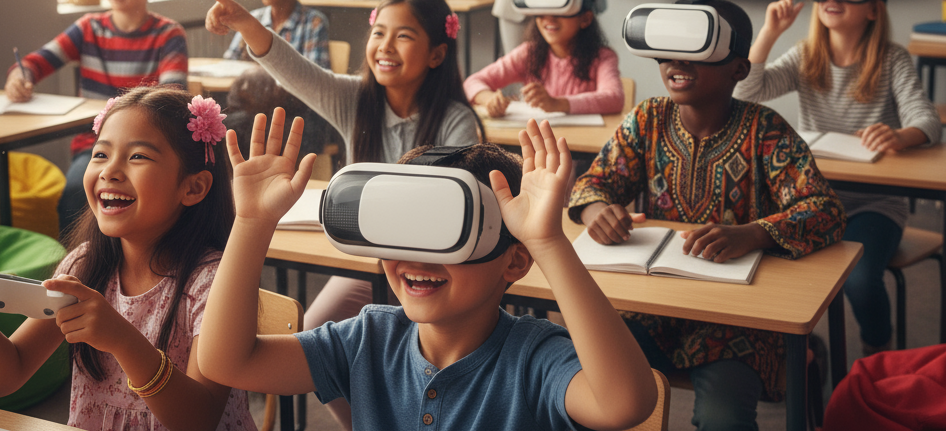
Artificial intelligence is no longer knocking… it’s sitting at the desk, both promising help and raising hard questions about equity and human dignity. UNESCO’s new paper, AI and the Future of Education: Disruptions, Dilemmas and Directions, brings together global voices who refuse to offer simple answers. Instead, they push us to wrestle with the contradictions AI introduces into education: efficiency vs. reflection, personalization vs. equity, innovation vs. dignity.
In her foreword, Stefania Giannini captures the paper’s central tension: “education is now a battleground where commercial AI models promise scale and efficiency, but risk eroding human practices (deep learning, reflection, and connection) that education depends on.”
Emily Bender (who spoke at Digital Learning Week 2025) warns against believing that “tech company visions of AI can fix education’s complex challenges.” While others argue that without real classroom support, AI risks becoming performative in nature and simply checking accessibility boxes without improving learning.
AI won’t fix education on its own. Rather, lasting change depends on people, context, and pedagogy.
Generative AI has forced educators to question traditional testing. Mike Perkins and Jasper Roe argue assessments are increasingly unreliable, while Bill Cope, Mary Kalantzis, and Akash Saini imagine AI-enabled feedback loops that could make assessment more continuous and human-centered.
Generative AI exposes the limits of old exams but also gives us a chance to create more authentic ways to measure learning.
Ching Sing Chai, Jiun-Yu Wu, and Thomas Chiu remind us that education is not the transmission of knowledge alone, but the cultivation of autonomy and participation. Arafeh Karimi pushes that idea further with sharing what is considered “compassion by design,” calling for AI systems that defer to educators’ judgment and attune to learners’ emotions. Teachers remain central and AI should support their judgment and relationships, not replace them.
The paper is clear: AI risks widening divides. Without intentional design, AI will deepen divides; with co-design, it can expand access and creativity for learners.
Báyò Akómoláfé challenges us to see AI not just as a tool but as a “crack” in the modern story that is forcing education to dwell in disorientation and to reimagine what it means to learn (love those words!). These ideas may feel abstract, but they push us to ask bigger questions about intelligence, agency, and the deeper purpose of education.
Kaśka Porayska-Pomsta and Isak Nti Asare propose an ethics of care by design, where equity and dignity are present from the outset, rather than attempting to retrofit ethics after deployment. Kalervo Gulson and Sam Sellar describe “synthetic governance,” where human and machine decision-making merge and are already raising urgent questions about democracy and accountability.
George Siemens argues that we need to be aware that “AI is statecraft.” Sharing how nations are leveraging AI for power, making its educational governance a matter of global competition. While Ilkka Tuomi urges policymakers to rethink what counts as evidence, calling for collective sense-making rather than one-size-fits-all solutions.
For those working at the intersect of AI and education a few things stood out in UNESCO’s paper as challenges, expectations, and critical reminders as the field continues to move forward.
- Educators and learners must shape AI tools as co-creators. We need to think carefully about how many tools are created in search of a problem. Likewise, we need to think about how problems in search of tools can be bolstered by leaning heavily on co-design with the people working, living in, and participating in education. The outcomes, I would guess, are in stark contrast to those tools and systems that are simply created for not with.
- AI cannot be launched into classrooms without cultural and local adaptation. We need to be constantly aware that context matters, and implementation of AI must have contextual relevance to make an impact. This isn’t an “out of the box” product in most cases — we need to keep that in mind.
- Traditional exams are increasingly obsolete; AI demands more dynamic and formative models. It is not just time to rethink but reconceptualize what assessment is for educators and educational systems. This area will more than likely stretch our thinking, and it is an area where I am excited to see what comes next. If assessment is being reshaped, so too must our understanding of the teacher’s role in guiding learning
- We need to consider two important question: How would things look different if our starting anchor for anything dealing with AI and education was the expectation that all things (tools, frameworks, benchmarks, apps, chatbots, LLMs, etc.) were born equitable and inclusive? What would it look like if AI was equitable by design instead of an afterthought?
- The teaching profession (including teacher training personnel, policy makers, leaders, and teachers) must be strengthened, not automated away. We cannot create human-centered AI in education without informed humans cultivating the implementation of these new technologies and opportunities with insight, knowledge, curiosity, and necessary skepticism.
I appreciate that this paper resists neat conclusions. Instead, it opens space for what UNESCO calls a “global commons for dialogue and action”. Its greatest strength is refusing the extremes (most notably AI utopianism and dystopian rejection).
For education leaders, the call is clear: AI futures are still being written. If we are deliberate, we can construct AI futures in ways that uphold dignity, inclusion, and human flourishing. If we are not, others will write those futures for us. UNESCO reminds us that this work cannot be done in isolation. Rather, it calls for a collective of educators, policymakers, technology companies, EdTech developers, and communities to shape AI together.
The full text of the report AI and the Future of Education: Disruptions, Dilemmas, and Directions can be found at https://www.unesco.org/en/articles/ai-and-future-education-disruptions-dilemmas-and-directions?hub=83250
Jody is a thought leader in education and a champion for women in leadership and designing learning spaces and practices that are inclusive for all. You can follow her work at jodybritten.com. You can subscribe to Jody’s newsletter to get weekly updates delivered right to your in-box at https://jodybritten.medium.com/subscribe.