
Here’s a curated list of recent global AI and learning developments worthy of your attention as educators, school leaders, and EdTech developers. This is all in an effort to help you stay informed and agile.
Top of Mind: The Illusion of Learning: The Danger of Artificial Intelligence to Education
During a call this week Robert Pondiscio’s essay The Illusion of Learning: The Danger of Artificial Intelligence to Education came up. This is a must read post that raises an important question that many education leaders are now confronting: what does authentic learning look like when AI can perform the visible parts of thinking for us?
As a staunch advocate for authentic, purposeful learning for all children, my attention peaked when Robert suggested that with a focus on “polished outputs” we completely ignore the important part. As I have said before our attention to outputs/tasks/assignment completion is akin to talking about the incredible meal you prepared for your guests, without acknowledging that you ordered it from the fast food joint down the street. As Robert suggests, attention to shiny outputs“masks the absence of cognition behind it.”
In his post, Robert warns that schools may be mistaking the presence of AI tools for progress, creating an illusion of learning rather than strengthening the human capacity that real education requires.
He argues that the true danger of AI in education is not automation itself, but complacency. Complacency, as suggested, is the result of what happens when systems adopt AI without re-examining their theory of learning, governance, and educator preparation.
Robert’s message is a timely one. As institutions expand AI pilots and digital strategies, the challenge is not simply to teach students how to use AI but to equip them with the judgment, critical thinking, and ethical grounding to question what AI produces.
The future of education will depend less on the sophistication of our tools and more on whether we design systems that keep curiosity, discernment, and human understanding at the center of learning.
Read all of Robert’s post at https://thenext30years.substack.com/p/the-illusion-of-learning-the-danger, I promise it will be worth your time.
A New Report: Higher Education + Young Americans
As many of you know I do a lot of consulting in higher education — helping organizations internationally to retool their approach and strategy. For me, the question is never whether higher education is worthwhile, but more often whether the investment feels worthwhile to today’s young people. That’s why when this new report from the Sine Institute hit my inbox I gave it more than one read. In this report, the institute shares their findings from a national survey of over 1,200 young Americans (ages 18–34) and briefly highlights a gap between the demand for AI readiness and the reality of learning experiences that prepare students for it.
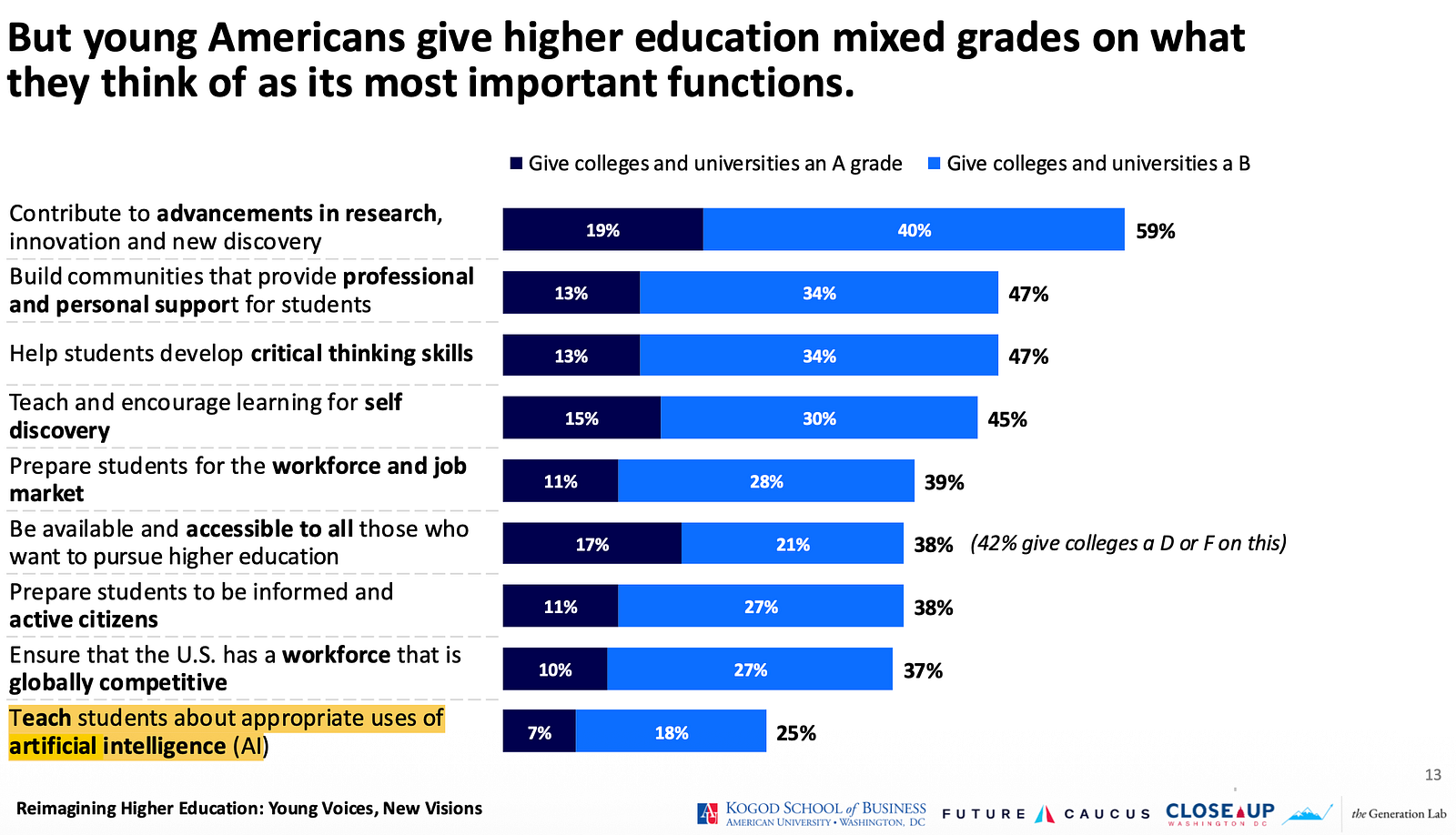
Nearly three in four respondents said that learning how to use AI responsibly is essential for success in work and life, yet 78% reported that AI was either not covered or actively discouraged in their high school experience.
The data suggests that young people see AI as a missing skill in their own education.
While many view college as a path to opportunity, they also question whether higher education is keeping pace with what the workforce and the world now require. Students are asking for responsible, career-aligned AI learning, and systems that fail to deliver it risk widening (not closing) the divide that seems to be widening on AI readiness. You read the full report at https://www.american.edu/sine-institute/upload/2025-sine-survey-full-results-final-57-read-only.pdf
A New Chapter at OpenAI
This week I was able to attend an event where the Chief Strategy Officer at OpenAI shared more about their next chapter. Here is what I found out.
- OpenAI has formally restructured its organization to align its rapid technical growth with long-term mission integrity.
- The new design centers around the OpenAI Foundation, a nonprofit entity that governs the OpenAI Group (its public benefit corporation).
- The foundation begins with a $25 billion commitment and holds equity valued at roughly $130 billion, placing it among the most well-resourced philanthropic bodies globally.
- This move reflects an attempt to balance research freedom, compute access, and ethical guardrails while maintaining investor confidence.
- Unlike traditional foundations, OpenAI’s can deploy capital immediately.
- For education and nonprofit leaders, two signals stand out. First, OpenAI’s People First AI Fund will invest $50 million in partnerships with community organizations, including those in education and environmental sectors. Second, the foundation’s scale suggests a growing global infrastructure for aligning AI innovation with public good — an area that will increasingly shape how schools, universities, and civil organizations interact with frontier AI.
Read their full post about this shift at https://openai.com/index/built-to-benefit-everyone/
AI News from Around the Globe: Updates from U.S., India, Morocco, and Kenya on AI and Education
AI Updates from the United States
Google and Internet2 have launched a new AI Education Leadership Program for higher education institutions in the United States. The program seems to be designed to support responsible adoption of tools such as Gemini for Education and NotebookLM. The partnership focuses on building a shared framework and community of practice to move beyond isolated pilot projects. This signals that higher education is formalizing AI adoption, not treating it as an experiment.
For schools and learning organizations, the takeaway is that governance, capacity building, and infrastructure planning for AI are becoming essential, not optional.
Read the full post at https://blog.google/outreach-initiatives/education/internet2-ai-leadership-higher-education/
The team at University of Texas at Dallas developed a neuro-morphic computer prototype that mimics brain-like architecture to learn patterns and make predictions using significantly fewer training computations than conventional AI systems. This reduces reliance on massive data-centres and high-power training regimes, opening the possibility of AI systems that run efficiently on smaller devices with lower energy footprints.
For education and technology leaders, this suggests that the next generation of AI tools could be more accessible, lighter on infrastructure, and better suited to low-resource settings.
That shift signals that when you are designing an EdTech strategy you can start assuming not only cloud-heavy models but also edge-capable, on-device AI tools that align with micro-schools and after-school contexts. Read the full post at https://news.utdallas.edu/science-technology/neuromorphic-computer-2025/
It’s important to note that even though this more engineering-ish than classroom-ish, school-based AI tools could become more accessible, especially in low-resource settings.
Updates from India on AI and Education
Classrooms across India are beginning to introduce AI-enabled computers that act less like tools and more like partners in learning. These devices can adjust to each student’s pace, flag misunderstandings, and help teachers manage their workload. Behind the innovation are serious questions about privacy, fairness, and how to keep human teaching at the center of learning. This is really a story about how schools choose to define learning in an age of automation. Read the full post at https://timesofindia.indiatimes.com/education/news/ai-in-classrooms-friend-or-foe-benefits-boundaries-and-why-learning-is-still-a-human-act/articleshow/124956167.cms
Africa + AI and Education: A few updates this week
Across Africa, AI tools are beginning to find a place in classrooms where teachers are few and learning resources are scarce. The hope is that smart systems can help personalize instruction, fill teaching gaps, and give students new ways to practice skills that would otherwise go untaught. Yet the promise comes with weighty challenges, including issues such as unstable internet access, uneven teacher preparation, and the ongoing risk that imported AI systems might overlook local languages and culture. AI could help close learning gaps if it is built and implemented with local realities in mind. You can read the full post at https://www.engineeringforchange.org/news/ai-in-the-classroom-can-bridge-africas-education-gap/
Kenya has launched a coordinated national effort that has already trained over 600 000 people in AI skills across government, industry and education.
The program links public sector training, university curriculum reform, and community programs to build broad-based capacity rather than isolated pilots.
For leaders in educational technology and organizational development this matters because it shows how a country can move from experimenting with AI to building a scalable ecosystem of people, platforms and credentials.
It signals that the barrier is not just technology, but coordination, pathways, and infrastructure. And it invites you to ask how this kind of structured, multi-stakeholder approach could inform your own work on AI and education. You can read the full post at https://dig.watch/updates/kenya-leads-the-way-in-ai-skilling-across-africa
Last but not least, I have spoken about movement in Morocco previously. This week I wanted to highlight the news that their government has launched a nationwide initiative called the National Programme for Children in the Fields of Digital and Artificial Intelligence, as part of its Digital Morocco 2030 strategy. It begins by expanding into 12 cities through youth centers, training 65 facilitators to work with children, and emphasizing safe, ethical, and culturally relevant use of digital and AI tools. This is a good example of how policy and practice can combine to achieve sustainable and measurable outcomes towards AI-literacy. You can read more about this effort at https://www.globalgovernmentforum.com/morocco-launches-national-ai-and-digital-skills-programme-for-children.
Remember that the future of education is being shaped now and we need more voices that are informed, thoughtful, and equity-driven. We need informed, thoughtful voices to make meaningful choices. Subscribe to Jody’s newsletter for weekly updates as soon as they’re published at https://jodybritten.medium.com/subscribe